
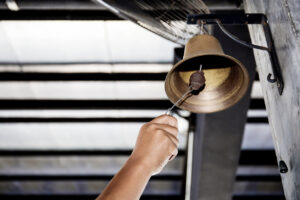
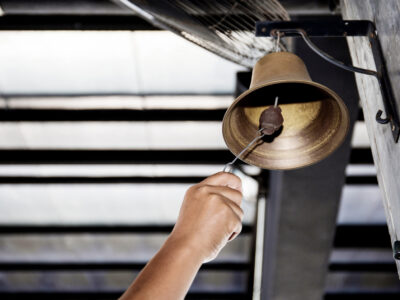
A brass bell hangs on the wall of every cancer center like a beacon of hope. Ring it three times when you’re done with treatment, the tradition says. Celebrate your victory. Announce to the world that you’ve beaten cancer.
Except it doesn’t feel like victory.
I rang that bell after months of radiation and chemotherapy for colorectal cancer. I was only able to do that because we caught it in time. That story starts with a screening. While nurses cheered and fellow patients smiled weakly from their infusion chairs, I mumbled through the traditional verse and wondered why I felt more relief than triumph, more anxiety than joy.
Finishing cancer treatment completion is nothing like finishing an Ironman, completing a marathon, earning a Ph.D or any other achievement I’d worked toward. Those victories felt earned, definitive, and celebrated without reservation. Cancer treatment completion feels more complicated. It’s layered with uncertainty, survivor’s guilt, and the ever-present fear that this might not be the end of the story.
The Mythology of Cancer Victory
Our culture loves a good cancer narrative: brave warrior battles disease, endures treatment with grace, rings bell triumphantly, returns to normal life stronger than before. It’s a tidy narrative that makes everyone – patients, families, medical staff, and society at large – feel better about a horrible disease.
But real cancer doesn’t follow a Hollywood script.
The bell-ringing ceremony assumes that cancer has a clear beginning, middle and end. In reality, cancer is more like an ongoing conversation with your own mortality that begins with diagnosis and never really stops. Even with “No Evidence of Disease” stamped on your medical records, you’re left with a lifetime of scans, blood tests, and the persistent fear that the monster will rise again. It’s a long-term test of endurance and mental toughness, just like athletic training, something I explore in more depth in my article, “8 Lessons About Resilience in the Face of Adversity“, where I reflect on how Ironman training shaped my approach to survivorship.
When I completed my first Ironman, I knew exactly what I’d accomplished: 2.4 miles of swimming, 112 miles of cycling, and 26.2 miles of running. The math was simple, the achievement measurable, the victory absolute. Cancer treatment isn’t like that. You don’t conquer cancer through superior training or mental toughness – you endure it, you survive it, but “beating” it always requires.
The Survivor’s Paradox
Standing next to that bell, surrounded by Jillian and hospital staff who genuinely wanted to celebrate with me, I couldn’t shake the feeling that I hadn’t done anything heroic. I’d shown up to appointments, dutifully swallowed pills, sat still during radiation, and let chemicals flow through my body. The real heroes were the medical team who designed my treatment protocol and the researchers who developed the drugs that saved my life. It was the people around me — friends, family, caregivers — they were heroes. More about how those relationships played a part here.
Yet everyone kept calling me brave, strong, and inspiring. The disconnect was jarring. Bravery implies choice; I didn’t choose to have cancer any more than I chose to survive it. I simply did what anyone would do: whatever it took to stay alive.
This is the survivor’s paradox: being celebrated for an experience you wouldn’t wish on anyone, feeling grateful for an outcome that was largely out of your control, and carrying the weight of knowing that others with similar diagnoses didn’t make it to their bell-ringing moment.
The Complication of Comparison
What makes cancer “victory” even more complicated is the presence of others who aren’t done fighting. As I rang the bell, I was acutely aware of patients still in treatment – some facing their third or fourth recurrence, others dealing with metastatic disease that might never be cured.
How do you celebrate in front of someone whose cancer journey may not have a bell-ringing moment? How do you express joy about finishing treatment when the person in the next chair is starting their second year of chemotherapy with no end in sight?
The tradition, while well-intentioned, creates a hierarchy of cancer experiences. There are the “bell ringers”—those who complete treatment and move on—and everyone else. But cancer – with all its complexities – doesn’t sift out into neat categories. Some people’s victories are quieter: stable scans after months of uncertainty, pain-free days during palliative care, or simply choosing to keep fighting when everything seems hopeless.
Redefining Victory
After wrestling with these complicated feelings, I’ve come to believe that cancer victory isn’t about ringing a bell or reaching the end of treatment. It’s about showing up – to appointments, to difficult conversations, to life itself – when everything inside you wants to hide.
Victory is choosing hope when statistics suggest otherwise. It’s being vulnerable enough to accept help when you’ve spent your life helping others. It’s finding moments of joy and normalcy in the midst of chaos. It’s treating family and friends with patience when the side effects make you irritable. It’s continuing to plan for the future while living fully in the present.
Maybe victory is also giving yourself permission to feel complicated emotions about completing treatment – relief mixed with anxiety, gratitude tinged with guilt, hope tempered by caution. Endurance training had taught me to hold discomfort — physical and emotional — without backing down. More about that life-saving mindset here.
A Different Kind of Finish Line
The bell-ringing tradition serves an important purpose—it provides closure for patients and hope for others still in treatment. But perhaps we need to expand our definition of what deserves celebration in cancer care.
What if we rang the bell not just for treatment completion, but for every small victory along the way? The first day you keep food down during chemo. The scan that shows your tumor shrinking. The moment you laugh out loud for the first time post-diagnosis. The day you realize you went an entire hour without thinking about cancer.
These victories might not come with brass bells and cheering crowds, but they’re no less significant. They’re the real markers of resilience, the true measures of how we respond when life throws us its toughest challenges.
I rang that bell and I’m grateful for the tradition, flawed as it may be. But my real victory wasn’t in completing treatment. It was in learning to live fully with uncertainty, to find meaning in struggle, and to appreciate each ordinary day as the extraordinary gift it truly is.
That’s a victory worth celebrating, bell or no bell.

Leave a Reply