

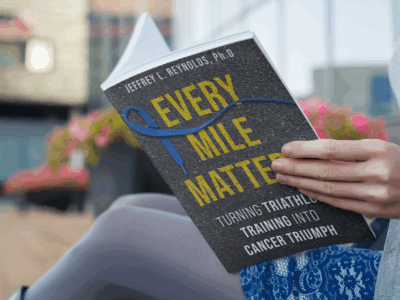
When Jeffrey L. Reynolds crossed the finish line at Ironman Florida in November 2021, he thought he had conquered one of life’s ultimate endurance challenges. At 55 years old, after swimming 2.4 miles, biking 112 miles, and running a full 26.2-mile marathon, he had earned the coveted title that less than one percent of the world’s population can claim. But just five months later, a routine physical would thrust him into a different kind of race—one he never signed up for, but one that would teach him lessons no triathlon ever could.
In one of the best books on mental toughness, “Every Mile Matters: Turning Triathlon Training Into Cancer Triumph,” Reynolds chronicles his journey through two cancer diagnoses in two years: prostate cancer followed by Stage 3B colorectal cancer. What emerges is not just a survival story, but a masterclass in resilience that reveals how the disciplines we develop in one arena of life can carry us through the most unexpected challenges in another.
Here are eight transformative themes from Reynolds’ journey that offer guidance for anyone facing their own seemingly impossible race.
1. Trust Your Training: The Foundation of Resilience
Reynolds’ first major insight came as he lay in a hospital bed after prostate surgery, realizing that cancer hadn’t caught him completely unprepared. “I had unknowingly been training for this battle my entire athletic career,” he writes. The discipline of waking at 4 AM for training runs, the mental toughness developed during grueling century bike rides, and the ability to push through discomfort during marathon “walls” had built what he calls “physical, emotional, and spiritual money in the bank.” It’s the kind of preparation you read about in mental toughness books, but lived out in real time.
This principle extends far beyond athletics. Every challenge we voluntarily undertake, whether learning a difficult skill, maintaining a challenging relationship, or pursuing an ambitious goal, deposits resilience into our emotional bank account. Reynolds discovered that the countless hours he’d spent doing hard things when he didn’t have to prepared him to do even harder things when he had no choice. That mindset, what some would call a resilient mindset, became one of his greatest assets.
This idea is echoed in his reflection on how he views the body not as a temple, but as a training ground for the unexpected.
The lesson here isn’t that everyone needs to become an Ironman. Rather, it’s about recognizing that strength and resilience are built through consistent practice with manageable difficulties. As Reynolds puts it, “Powering through hard things prepares you for hard things.” Whether it’s committing to a daily meditation practice, learning a new language, or simply choosing the stairs over the elevator, we’re all constantly in training for resilience in the face of adversity, even if we don’t realize it yet.
2. Embrace Vulnerability as Quiet Strength
Perhaps nowhere is our culture’s relationship with vulnerability more complicated than in how we discuss illness, particularly among men. Reynolds initially struggled with asking for help, admitting weakness, or showing the full impact of his treatments. “I’m the helper, not one to be helped,” he confesses, describing decades as a nonprofit executive supporting others through their darkest moments while maintaining his own armor.
Cancer systematically dismantled this carefully constructed persona. There was no hiding vulnerability when discussing basic bodily functions with nurses, no maintaining control when doctors dictated treatment protocols that would alter his life for months. But this forced authenticity became a source of unexpected strength.
Drawing on Brené Brown’s research, Reynolds discovered that vulnerability isn’t the opposite of strength—it’s strength’s most authentic expression. When he began sharing his journey publicly through blog posts and social media, the response overwhelmed him. Friends revealed their own secret battles, strangers offered comforting words for someone with cancer, and fellow cancer patients found solace in his honesty.
“Real connections depend on authenticity,” Reynolds writes, “and continual growth requires vulnerability—not as a spectator barking orders from the sidelines, but as an active and equal participant.” The very experiences that initially felt like weakness—needing help, feeling afraid, crying unexpectedly—became the foundation for deeper relationships with friends and more meaningful connections with others.

3. The Transformative Power of Purpose
Facing mortality has a way of clarifying what truly matters. For Reynolds, cancer didn’t just threaten his life, it crystallized his purpose. “If I hadn’t been diagnosed with cancer, I probably would have gone to my grave with this book still inside me,” he reflects.
His purpose evolved beyond personal survival to encompass service to others facing similar battles. He volunteered for a clinical trial, knowing his participation could help future patients. He spoke publicly about the importance of early screening, potentially saving lives through awareness. He transformed his private struggle into public advocacy, using his platform as a nonprofit executive to address healthcare disparities, offer support for cancer patients, and promote equitable access to treatment.
But purpose doesn’t have to be grandiose to be transformative. Reynolds discovered that clarity about his “why”—being present for his children’s milestones, growing old with his wife Jillian, continuing his work in the community—provided motivation during the darkest treatment days. When physical strength failed, mental toughness developed in training equipped Reynolds for a level of resilience in the face of adversity that carried him to the other side.
This theme in Every Mile Matters offers a crucial lesson for anyone facing adversity. Identifying what we’re fighting for can be as important as understanding what we’re fighting against. Purpose becomes the North Star that guides us when the path becomes unclear and the destination seems impossibly distant.
This purpose-driven approach is also what inspired him to advocate for routine cancer screenings, the very tool that saved his life twice. Read Reynolds thoughts on that in, Cancer Screenings Saved My Life Twice.
4. Community as Lifeline
Despite triathlon being an individual sport, Reynolds emphasizes that “no one does a triathlon alone.” The same principle applies to cancer and to all of life’s major challenges. Behind every finish line celebration are coaches, training partners, volunteers, medical staff, and countless others who make those achievements possible.
Cancer introduced Reynolds to multiple communities of support. There was his immediate circle—Jillian, who attended every appointment and treatment session; his children, who provided motivation to fight; his medical team, who became trusted guides through an unfamiliar landscape. But support also came from unexpected places: the “secret society” of cancer survivors who quietly checked in on each other, the online communities sharing practical tips for managing side effects, even strangers who reached out after reading his blog posts.
Reynolds learned to both receive and provide support within these communities. He mentored newly diagnosed men, participated in clinical trials that would benefit future patients, and used his platform to raise awareness about screening and early detection. This reciprocal relationship—being helped and helping others—became a crucial component of his healing process.
The lesson extends beyond crisis situations. Reynolds observed that “the happiest and most successful people tend to have the largest and deepest social networks.” Building and maintaining these connections before we need them creates a foundation of support that can sustain us through unexpected challenges.
5. Finding Gratitude in the Midst of Struggle
One of the most counterintuitive themes in Reynolds’ cancer journey is how the disease deepened his capacity for gratitude. “You find yourself grateful just for making it through a radiation session without needing to jump off the table,” he writes, describing how his perspective shifted toward appreciating the smallest victories.
This wasn’t toxic positivity or denial of cancer’s harsh realities. Instead, it was a recognition that gratitude could coexist with legitimate fear, anger, and sadness. Reynolds developed what he calls “emotional agility”—the ability to hold multiple feelings simultaneously without being overwhelmed by any single emotion.
Cancer became an unexpected teacher in mindfulness, forcing Reynolds to live more fully in the present moment. “Gratitude can be a spontaneous feeling of warmth or a fleeting emotion,” he explains, “but it can also be a process and a practice for navigating cancer and fully appreciating life.”
This practice extended beyond his treatment. Reynolds began noticing beauty in ordinary moments—morning sunrises, conversations with friends, the simple pleasure of food tasting normal again after chemotherapy. He discovered that training in gratitude is similar to training like an athlete—gratitude strengthens with regular exercise.
The broader application is profound: we don’t have to wait for a crisis to develop this muscle. Regular gratitude practice, whether through journaling, meditation, or simply pausing to acknowledge daily gifts, builds resilience for whatever challenges may come.
6. Redefining Athlete Mentality Beyond the Physical
As someone who had built his identity around physical prowess, Reynolds faced a reckoning when cancer treatment stripped away his athletic abilities. Chemotherapy left him winded after climbing stairs, unable to complete the training runs that had once been second nature. “I watched my fitness slip away, and it was hard to face,” he admits midway through the book.
But this loss led to a broader understanding of what true fitness means. Reynolds began to see fitness as “a balanced ability to enjoy a fulfilling life with the grace, endurance, and strength that leaves the world a better place.” This holistic definition encompasses physical health but extends to emotional, spiritual, and social wellness.
He discovered that emotional fitness—the ability to process and express feelings constructively—was as important as cardiovascular health. Spiritual fitness—connection to purpose and meaning larger than oneself—provided strength when physical energy failed. Social fitness—the capacity to build and maintain meaningful relationships—created networks of support that sustained him through treatment.
This reframing offers liberation from narrow definitions of health and success. True fitness isn’t about running faster or lifting heavier weights—though those can be components. It’s about developing comprehensive resilience that serves us across all dimensions of human experience.
This expanded view of fitness is what enabled him to “ring the bell” after cancer treatment with mixed emotions and a new understanding of true victory. Read more on that moment in Reynold’s article, Ringing the Bell: Why Cancer ‘Victory’ Feels So Complicated.
7. Resilent Mindset and The Paradox of Control and Surrender
Reynolds’ endurance sports experiences had taught him to control variables—training schedules, nutrition, pacing strategies. Cancer confronted him with the limits of control in stark terms. “I couldn’t figure out why in God’s name I could possibly have gotten cancer if I exercised regularly, ate fairly well, and had zero symptoms,” he writes, describing his initial frustration with the disease’s randomness.
This led to one of his most profound insights: the difference between control and surrender. In athletics, surrender often means giving up. In cancer treatment, surrender meant accepting help, trusting his medical team, and acknowledging that some outcomes were beyond his influence. Having a resiliant mindset means focusing energy on what he could control—his attitude, his treatment compliance, his relationships—while releasing attachment to what he couldn’t.
“Surrendering isn’t the same as giving up,” Reynolds learned. This paradox runs throughout his story: fighting fiercely while accepting uncertainty, preparing meticulously while remaining flexible, maintaining hope while acknowledging difficult realities. That’s resiliency.
This theme offers guidance for anyone facing situations that challenge their sense of agency. The key isn’t choosing between control and surrender, but learning when each is appropriate and how they can work together.
8. Transformation Through Adversity
Reynolds concludes his journey with a powerful realization: cancer, despite its devastation, had offered unexpected gifts. “I felt more alive, more curious, more appreciative, and more authentic than ever before,” he writes. The disease that threatened to end his life had, paradoxically, taught him how to live more fully.
This transformation wasn’t automatic or inevitable. It required conscious choice and consistent effort. Reynolds had to decide whether to merely survive his experience, recover from it, or use it as a catalyst for growth. He chose transformation, embracing cancer not as something that happened to him, but as something that revealed who he could become.
The changes were comprehensive: deeper relationships built on vulnerability and authenticity, clearer purpose focused on service and meaning, heightened appreciation for ordinary moments, and increased emotional intelligence and spiritual depth. Cancer had stripped away illusions and pretenses, revealing what truly mattered.
The Finish Line That Becomes a Starting Line
Reynolds’ story challenges us to reconsider how we think about life’s most difficult challenges. Rather than viewing adversity as something to simply endure or overcome, he demonstrates how struggles can become teachers, wounds can become wisdom, and our greatest vulnerabilities can become sources of strength and purpose.
“Every mile matters,” he writes, referring both to the athlete mentality and his cancer journey. Each step of difficulty, each moment of doubt overcome, each choice to continue when stopping seemed easier—all contributed to a reservoir of resilience that served him when he needed it most.
His message isn’t that we should seek out suffering or romanticize illness. Rather, it’s that we can choose how to meet the challenges that inevitably come. We can develop practices, relationships, and perspectives before we need them. We can build the physical, emotional, and spiritual fitness that will serve us when life inevitably asks more of us than we think we can give.
As Reynolds discovered, sometimes the race we never wanted to run becomes the one that teaches us who we’re truly capable of becoming. Every mile—every moment of struggle, growth, and grace—matters more than we know.
Jeffrey L. Reynolds’ “Every Mile Matters: Turning Triathlon Training Into Cancer Triumph” is available now. His story continues at JeffreyReynolds.com, where he shares ongoing insights about resilience, leadership, and living with purpose.

 Cancer Screenings Saved My Life Twice (And Why You Can’t Skip Yours)
Leave a Reply